
Latest news

An AI demand forecasting engine built for every planning horizon
The e2open Demand Sensing forecast engine applies AI and machine learning to historical sales, current orders, promotions, point-of-sale data, leading indicators, and other downstream demand signals. It then selects and tunes the best forecasting approach for each item, location, and channel, on the horizon that matters.
The engine supports short-term execution through Demand Sensing and broader planning horizons through Demand Planning. Instead of running near-term and long-range forecasting as two separate problems, companies get one common forecasting intelligence layer that adapts as demand drivers change. That's the shift from periodic, manually tuned forecasting to AI demand forecasting that keeps pace with the market.

Key features and benefits

Applies AI-led forecasting across short- and long-term horizons, supporting both Demand Sensing and Demand Planning

Continuously refines algorithm and signal weighting as demand drivers change over time

Evaluates statistical and machine learning techniques to select the best fit for each item, location, channel, and time period

Supports Forecast Value Add (FVA) analysis in Demand Planning to measure when planner adjustments improve or degrade forecast accuracy

Integrates historical sales, current orders, promotions, point-of-sale data, leading indicators, and other downstream demand signals

Can improve forecast accuracy across near-term execution and longer-range planning horizons
Feature
AI-powered demand forecasting tools that evaluate statistical and machine learning techniques side by side
Integrates historical sales, current orders, promotions, point-of-sale data, and leading indicators
Continuously refines algorithm and signal weighting
Applies one forecasting intelligence layer across Demand Sensing and Demand Planning
Supports Forecast Value Add (FVA) analysis
Strengthens the AI-generated baseline forecast
Benefit
Selects the best-fit forecasting method for each item, location, and time period, instead of one model for everything
Builds a forecast on the demand signals that actually move the business, not history alone
Keeps the forecast current as demand drivers shift, without waiting on a manual re-tune
Connects near-term execution to longer-range planning instead of running them as separate problems
Shows planners and leaders where manual adjustments help or hurt accuracy
Gives planners a reliable starting point so they can focus effort on real exceptions
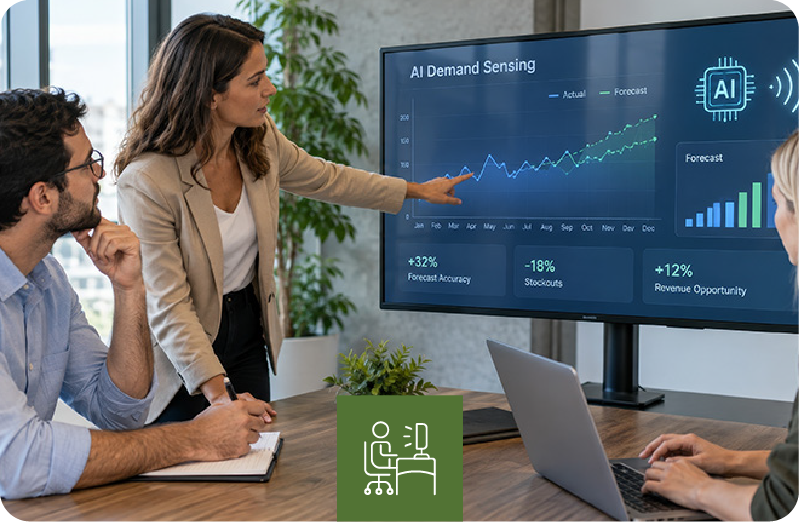
Connect short-term sensing with longer-range planning
Near-term and longer-range planning are often treated as two separate forecasting problems. Short-term execution teams need a current demand view for replenishment, inventory positioning, and service decisions. Demand planning teams need a reliable baseline for business planning, supply alignment, consensus review, and financial visibility.
The demand sensing forecast engine bridges those needs by applying the same forecasting intelligence across horizons. For Demand Sensing, it builds daily forecasts that reflect current market signals. For Demand Planning, it strengthens the baseline forecast used in longer-range planning and provides the foundation for measuring Forecast Value Add.
Make planner-AI collaboration measurable
The strongest forecasting process uses AI to read patterns at scale and planners to add context where the system lacks visibility. Forecast Value Add gives demand planning teams a way to measure that collaboration by comparing the AI baseline, the planner-adjusted consensus forecast, and actual demand.
Organizations can see where planners improve accuracy, where the engine should be trusted, and where forecast governance needs to change. That turns planner-AI collaboration into a repeatable operating model instead of an unmanaged series of overrides.

35-40%
forecast improvement on short-term horizons

10-20%
forecast improvement on long-term horizons

30-50%
planner productivity opportunity identified by focusing manual intervention where it adds measurable value
In one long-term planning case study, the AI-generated baseline achieved 62% Mean Absolute Percentage Error (MAPE).
Ready to build a smarter forecasting operating model?
See how e2open's AI-led forecast engine can help you build a stronger baseline across every planning horizon, and focus planner expertise where it adds measurable value.
FAQs
What is the difference between demand sensing and demand planning?
Demand sensing produces daily, near-term forecasts used for replenishment and execution. Demand planning produces longer-range forecasts that anchor consensus planning, supply alignment, and financial plans. e2open's demand sensing forecast engine applies the same AI-led forecasting intelligence to both.
How is demand sensing different from demand forecasting?
Demand forecasting is the broader discipline of predicting future demand at any horizon. Demand sensing is a specific, short-term application of it: using current signals like point-of-sale data and orders to adjust the forecast day to day, rather than relying on a periodic baseline alone.
What is demand sensing?
Demand sensing is the practice of generating near-term, item-location forecasts from current market signals, such as point-of-sale data, current orders, and leading indicators, so replenishment and execution teams can act on what's happening now rather than last quarter's forecast.
What is Forecast Value Add (FVA)?
Forecast Value Add is a method for measuring whether a planner's manual adjustment made a demand plan more or less accurate than the unadjusted AI baseline. It turns planner-AI collaboration into something you can measure and govern, rather than an unmanaged series of overrides. For a deeper look at how the two disciplines differ, see e2open's demand planning vs. demand forecasting blog post.
E2open subscription center
Subscribe to receive e2open updates
Interested in learning more? Stay current with the latest e2open news – from company updates to thought-leadership pieces, and so much more!