
Latest news
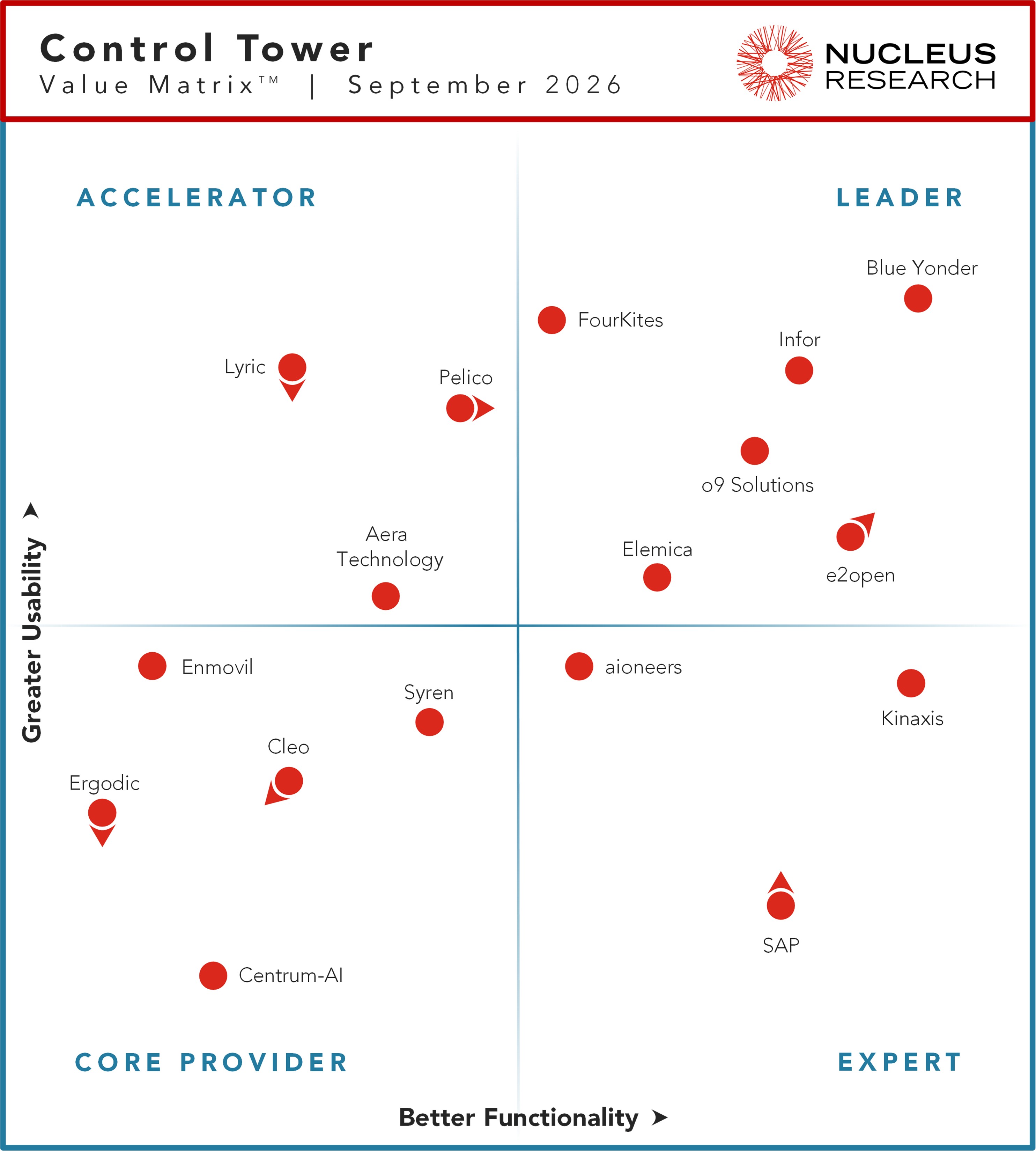
Nucleus recognized e2open as a Leader for running control tower as a cross-functional supply chain orchestration layer rather than a standalone visibility application. The report points to the See, Understand, Act, and Learn model that moves teams from exception detection through impact assessment, response evaluation, and execution. It cites the reach of e2open's multi-enterprise, n-tier partner network of more than 500,000 connected trading partners, and the shared data model that normalizes signals from internal systems and external partners, so decisions are made on one version of the truth.
Nucleus also highlights the breadth behind the command center. E2open’s channel distribution, supply chain planning, global trade compliance, transportation, and supply operations applications run on the e2open Connected Supply Chain Platform, giving planners, buyers, trade teams, plant teams, and logistics teams a single place to coordinate across executional, tactical, and strategic horizons. Supply Network Discovery extends visibility into sub-tier supplier relationships with BOM-level traceability, scorecards, and due diligence. Native global trade capabilities pull tariff, regulatory, and screening constraints into disruption response instead of leaving compliance as a separate queue. And the Agentic Digital Assistant is moving from answering planning questions toward coordinating action across connected workflows.

Connected supply chain orchestration
The control tower runs across channel, planning, global trade, logistics, and supply on one platform, so a signal and the response to it live in the same place.

N-tier visibility
More than 500,000 trading partners connected across customers, retailers, distributors, co-packers, direct suppliers, and deeper tiers.

See, Understand, Act, Learn
A closed operating model that moves from detection to impact assessment, response and feedback, rather than stopping at the alert.
What Nucleus Research evaluated in control tower software
Nucleus Research evaluates control tower software vendors on the usability and functionality of their software. The analysis examines how the vendor’s control tower connects signals across systems, functions, assets, and trading partners, ranks those signals by operational or business impact, supports analysis of the right response, and carries that decision into coordinated action. That action can run through a person, a workflow, an enterprise application, a trading partner, an automated process, or a software agent.
Key findings from the report
Nucleus identifies six shifts reshaping the control tower market in 2026. Together, they explain why visibility projects stall and why buyers now want decision support, not another screen.

The market is converging, but architecture still decides where you see value first
Planning, execution, visibility, manufacturing, and multi-enterprise network vendors are all attacking the same decision problem from different starting points, and Nucleus notes the category lines are blurring. Where a vendor started still matters: a manufacturer chasing material shortages needs production, BOM, and capacity context; a retailer needs inventory positioning, supplier milestones, and proactive receiving.
Visibility on its own no longer qualifies as a control tower
Flagging that an event occurred, without supporting the decision and the response, is visibility, not a mature control tower. The software has to connect the signal, rank it by impact, and open a route to coordinated action.
Operational context is the real differentiator
Detecting a late shipment is straightforward; working out whether it matters is where the value sits. A late load may need no intervention if inventory is available elsewhere, while a supplier delay on a constrained material can put high-priority production orders and customer commitments at risk. Buyers are paying to separate ordinary deviation from events that will hit service, cost, revenue, inventory, or production.
Decision velocity is becoming the measure of maturity
Nucleus frames decision velocity as the time from a relevant signal to an informed, executable response inside the operating window. Less mature teams find out after the schedule slips, or the customer order has already been hit. Mature teams compress that cycle toward real time; the most advanced combine live signals with historical patterns and known constraints to head off disruptions before operations feel them.
AI is evolving the category rather than reinventing it
Machine learning, optimization, and predictive analytics have been in control towers for years. What is new is generative and agentic AI taking on the manual work between insight and action: assembling supporting data, chasing suppliers, adjusting planning inputs, and initiating transactions. Buyers are not treating autonomy as all-or-nothing, and Nucleus notes that human-in-the-loop governance, explainability, confidence thresholds, and clear decision ownership matter as much as the model.
ROI comes from fewer disruptions, not more features
Static dashboards, data feeds, alerts, and AI features tell you nothing. Return on investment shows up as lower expedite spend, less inventory exposure, fewer backorders and escalations, better production utilization, and less time investigating exceptions. Nucleus recommends starting from one measurable problem with a baseline, then expanding into adjacent decisions.
Why this recognition matters for your supply chain
Disruption is no longer a quarterly event. Tariff changes, supplier failures, capacity swings, port congestion, and new compliance obligations arrive week after week, and the cost of a slow decision surfaces in service levels, margin, working capital, and customer trust.
Supply chain control towers are where those decisions get made, which is why the category has moved from a reporting layer to an operating layer. E2open's Leader placement gives supply chain leaders an independent read on what a connected control tower looks like in practice, and on the gap between a platform that reports a problem and one that helps resolve it.
For teams weighing whether to extend an incumbent visibility tool, stitch together point solutions, or connect planning, trade, logistics, and supply on a single platform, the Value Matrix is a useful independent benchmark.
Get the 2026 Nucleus Research Control Tower Technology Value Matrix
Fill out the form to download the report and see why Nucleus Research recognized e2open as a Leader in Control Tower Technology.
Frequently asked questions
What is the Nucleus Research Control Tower Technology Value Matrix?
It is an independent analyst report that evaluates supply chain control tower vendors on the usability and functionality of their software. The 2026 edition also examines market convergence, operational context, decision velocity, the practical role of AI, and how buyers are measuring ROI. Nucleus positions it as a snapshot of the market rather than an empirical ranking.
What does it mean to be named a Leader?
In the Nucleus Research Value Matrix, Leaders are vendors positioned strongly on both usability and functionality.
Why was e2open recognized as a Leader?
Nucleus recognized e2open for running control tower as a cross-functional orchestration layer across channel, planning, global trade, logistics, and supply, delivered over the e2net n-tier partner network with the Harmony user experience. The report cites the See, Understand, Act and Learn model, n-tier visibility that reaches deeper-tier suppliers, Supply Network Discovery with BOM-level traceability, native global trade capabilities, and expanding AI-enabled exception management including the Agentic Digital Assistant.
Who publishes the Control Tower Technology Value Matrix, and when was the 2026 edition released?
The Control Tower Technology Value Matrix is published by Nucleus Research, an independent analyst firm. The 2026 edition is Document 26161, dated September 2026.
What is the See, Understand, Act, and Learn model?
The See, Understand, Act, and Learn is the operating model e2open uses to run control tower as a closed cycle rather than an alerting tool. It moves a team from exception detection through impact assessment and response evaluation into execution, then feeds the outcome back into the next decision.
E2open subscription center
Subscribe to receive e2open updates
Interested in learning more? Stay current with the latest e2open news – from company updates to thought-leadership pieces, and so much more!