
Latest news
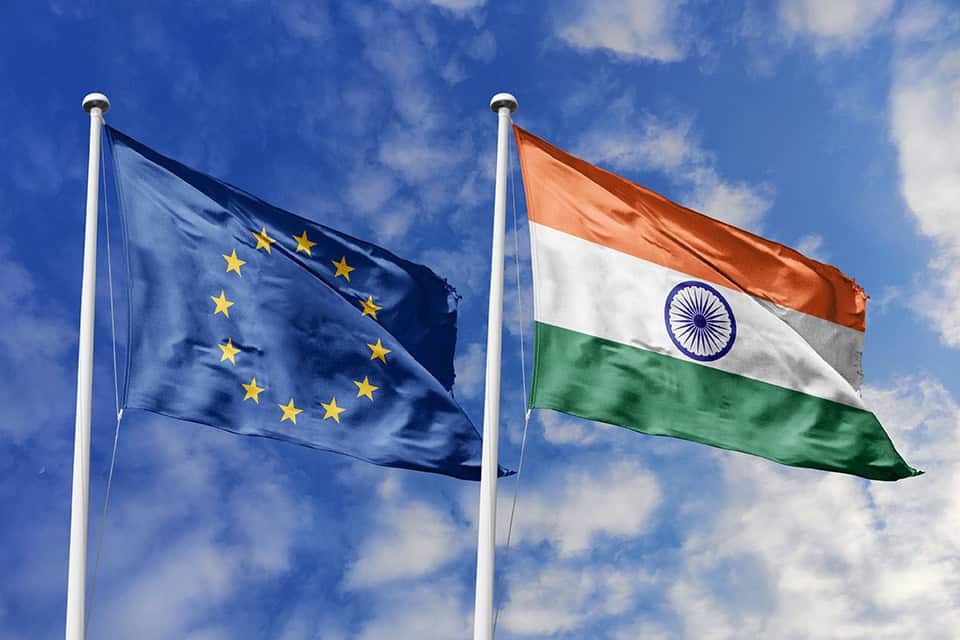
The newly announced India-EU trade deal is being hailed as “the mother of all deals”. After nearly two decades of on-and-off negotiations, India and the European Union finalized a historic free trade agreement (FTA), on January 27, 2026, designed to reshape global commerce, strengthen strategic ties, and create a powerful economic corridor.
This agreement connects the world’s most populous nation and a 27-member economic bloc into a free-trade zone representing nearly 25% of global GDP and one-third of global trade.
What key benefits this trade deal delivers to India and the EU
At its core, the India-EU free trade agreement slashes tariffs, expands market access, and simplifies trade between two large economies, delivering benefits to both sides:
- Lowered tariffs on European automobiles, agricultural products, wine, and other high-value goods, reducing import taxes that previously ran as high as 150% on premium wines and over 100% on cars.
- Tariff reductions on Indian textiles, leather goods, marine products, and gems and jewelry, sectors that have been especially impacted by recent US tariff hikes.
- Nearly all traded goods are included in this deal. India will reduce or eliminate tariffs on 96.6% of EU exports, and the EU will liberalize 99.5% of its tariffs on goods imported from India over seven years.
The European Commission estimates that European exporters alone could save up to €4 billion annually in customs duties.
Why this free trade agreement matters for supply chains
This announcement comes at a moment when the entire world is experiencing intense global trade uncertainty. Aggressive US tariffs on India and the EU have disrupted established supply chains and pushed major economies to diversify partnerships.
Both India and the EU are using this agreement to:
- Expand joint manufacturing
- Reduce dependence on volatile markets
- Develop more predictable regulatory environments
- Create a stronger foundation for long-term trade and investment flows
When will the India-EU trade deal take effect?
Although the deal has been agreed on, it must still undergo legal vetting and secure ratification from the European Parliament. Officials expect full implementation within the next year.
Ursula von der Leyen summed it up well, “Europe and India are making history today...We have created a free-trade zone of two billion people.”
How e2open can help businesses take full advantage of this FTA
E2open is uniquely positioned to help organizations capture the full value of this new India-EU trade deal.
Companies using e2open’s Global Trade Management platform can achieve:
- Typical duty savings of between 1.7% to 3.0% of total revenue by automatically identifying and qualifying products for Free Trade Agreements
- Up to 90%+ faster product classifications using AI-powered automation - reducing manual classification time from 15–30 minutes per item to near-instant suggestions
- The most accurate duty, tax, and landed cost calculations by leveraging continuously updated Global Knowledge® content – critical when new agreements introduce complex rules of origin
- Access to the world’s largest trade content database, covering more than 236 countries and territories, updated daily
As bilateral agreements reshape global commerce, companies equipped with accurate content, automated qualification, and unified global trade management tools can move faster, reduce compliance risk, and unlock substantial savings.
If you're looking to take full advantage of free trade agreements like this India-EU deal, we’re here to help. Contact us to learn how e2open can strengthen your global trade strategy and give your team the real-time intelligence they need to move faster and stay compliant.
Latest
Subscribe to Receive e2open Updates
E2open Subscription Center
Interested in learning more? Stay current with the latest e2open news – from company updates to thought-leadership pieces, and so much more!