
Latest news

Near-term forecasting matters most when inventory deployment decisions are being made.

Demand Sensing improved short-term accuracy without requiring planners to manually tune forecasts.

Artificial Intelligence (AI) forecasting and current demand signals helped the manufacturer respond to demand shifts faster.

Sustained MAPE and bias improvements supported better service, inventory, and cost outcomes.

A leading global consumer packaged goods (CPG) manufacturer set out to improve short-term forecast accuracy across a broad portfolio of everyday products, from tissue and personal care to healthcare categories.
The company already had an established demand planning process and a planning tool, but near-term performance was not consistently strong enough to guide inventory deployment, protect service levels, and reduce costly corrective action.
With e2open Demand Sensing, the manufacturer added a touchless, AI-led forecasting layer inside the near-term planning window, improving MAPE by 13% to 38%, reducing bias by up to 78%, and increasing confidence in inventory deployment decisions.
Why wasn't the existing demand planning process enough?
The manufacturer began with a statistical forecast, then enriched it through collaboration with sales, marketing, and other stakeholders. That process supported broader planning needs, but it did not provide the daily responsiveness required in the near-term horizon.
The business wanted a scalable way to improve short-term forecasting without adding manual work to an already complex planning process.


Near-term forecast performance was not consistently strong enough to support service-level and inventory goals.

Forecast errors increased the risk of sending inventory to the wrong locations.

Stockouts, excess inventory, and last-minute corrective action created avoidable cost and disruption.

Planners and analysts wanted better accuracy without additional manual tuning or intervention.
Adding an AI-led forecasting layer inside the near-term window
The company implemented e2open Demand Sensing to strengthen short-term forecasting inside the near-term seven-week planning window. The existing demand plan remained an important input, but once the forecast entered the near-term horizon, Demand Sensing generated updated forecasts using AI-led modeling and current demand signals.
Demand Sensing incorporated point-of-sale activity, store inventory, warehouse withdrawals, and open orders. It automatically selected and weighted the best-fit forecasting approach for each situation, continuously updating forecasts as new data became available.
Because the process was touchless, planners and analysts did not need to manually tune forecasts. The capability ran autonomously on a daily basis and routed updated forecasts back into downstream execution systems for distribution planning.

AI-led modeling improved forecast accuracy in the near-term window.

Current demand signals helped sense shifts closer to actual consumption.

Daily autonomous updates reduced reliance on fixed review cycles.

Touchless operation reduced manual tuning and analyst intervention.

Updated forecasts supported downstream inventory deployment and distribution planning.
The results: MAPE, bias, and inventory deployment gains
By adding Demand Sensing to its near-term planning process, the manufacturer achieved sustained improvement over its existing demand plan.

13% to 38% mean absolute percentage error (MAPE) improvement compared with the existing demand plan, depending on forecast horizon.
Up to 78% bias improvement, depending on the horizon measured.
Two years of historical performance confirmed sustained gains, not a one-time improvement.
Better short-term forecast accuracy increased confidence in inventory deployment decisions.
Reduced forecast uncertainty supported lower buffer stock requirements.

Application used:
e2open Demand Sensing
Proof point:
Two years of historical performance confirmed the gains were sustained, not a one-time improvement.
Why it matters
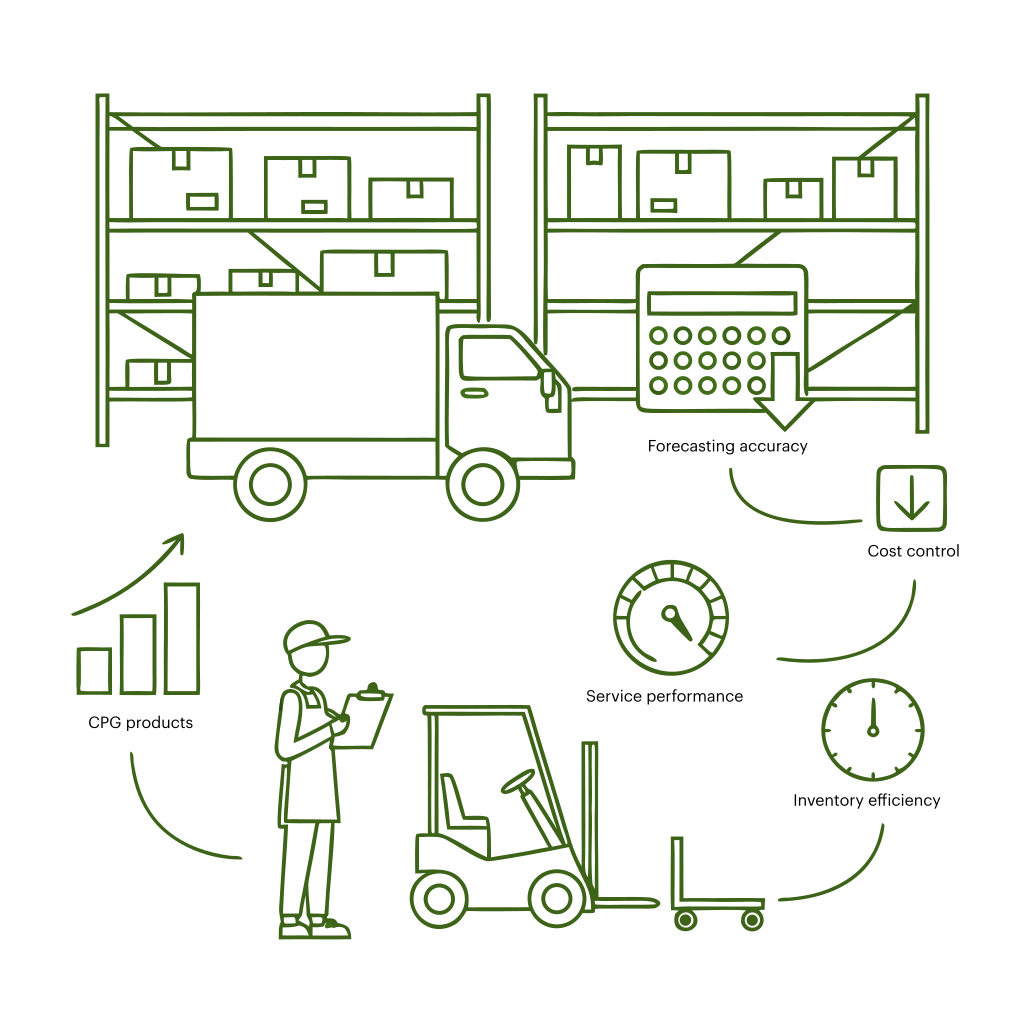
In fast-moving CPG supply chains, near-term forecast accuracy directly affects service performance, inventory efficiency, and cost control. When companies can sense demand shifts sooner and update forecasts daily, they can make better deployment decisions before disruptions turn into stockouts, excess inventory, or emergency action.
E2open Demand Sensing helps organizations bring AI-led responsiveness to CPG forecasting within existing planning processes, without adding manual planning burden.
Ready to improve near-term forecast accuracy?
Read the case study to see how a leading CPG manufacturer used Demand Sensing to improve forecast accuracy, reduce bias, and make more confident inventory deployment decisions.
FAQs
What is Demand Sensing?
E2open Demand Sensing is a short-term forecasting capability that uses current demand signals and AI-led modeling to update forecasts closer to actual demand.
How did Demand Sensing help this CPG manufacturer?
It improved near-term forecast accuracy, reduced forecast bias, and helped the company make more confident inventory deployment decisions without adding manual planning effort.
What results did the manufacturer achieve?
The company achieved 13% to 38% MAPE improvement and up to 78% bias improvement, depending on the forecast horizon measured.
Why is near-term forecast accuracy important for CPG companies?
It helps companies position inventory closer to expected demand, reduce excess buffer stock, avoid stockouts, and minimize last-minute corrective action.
E2open subscription center
Subscribe to receive e2open updates
Interested in learning more? Stay current with the latest e2open news – from company updates to thought-leadership pieces, and so much more!