
Latest news

How can companies make EUDR compliance a repeatable process?
EUDR compliance works best as an operating model, not a one-time project. Organizations need a way to identify in-scope products, collect sourcing and geolocation data, run EUDR risk assessment, and maintain due diligence records across teams, business systems, and trading partners.
The e2open Supply Suite brings these activities together in one environment: supplier collaboration, due diligence management, risk visibility, compliance automation, and compliance recordkeeping. It is connected EUDR compliance software built to support this regulation today and the broader supply chain due diligence requirements that follow it. See how the Supply Suite supports EUDR Compliance to see how the pieces fit together.
What should EUDR compliance software help companies manage?
Most organizations already have some visibility into direct suppliers. EUDR asks for more: evidence across multi-tier supply networks, built on supplier collaboration and structured EUDR due diligence workflows.
Key features and benefits
Feature | Benefit |
| Structured supplier collaboration for information collection | Faster supplier engagement and response cycles |
| Multi-tier supply chain visibility | Greater visibility into supplier networks and stronger supply chain transparency |
| Due diligence statement management, including support for TRACES-related regulatory data exchange | Lower compliance risk through repeatable due diligence processes and more consistent regulatory submission readiness |
| Geolocation data collection for compliance and supplier verification | Audit-ready evidence and a stronger documentation history |
| Supplier risk management across sourcing relationships | Consistent, risk-based decisions on where to focus review |
What does an audit-ready EUDR compliance process look like?
Supplier data only helps once teams can act on it. A structured EUDR risk assessment shows which suppliers need attention, which products carry risk, and which documentation is still missing, so reviews and corrective action follow a consistent path.
Coordinated reviews, approvals, and exception management keep that process moving. Centralized records make it possible to show an auditor exactly what was done, when, and why.

How can companies speed up supplier data collection for EUDR?
Structured requests and standardized data collection can shorten supplier response cycles and surface data gaps earlier, before they turn into compliance risk.

How does EUDR risk assessment help prioritize supplier review?
Integrated risk visibility helps teams prioritize investigations and focus resources on the suppliers and products that carry the most EUDR risk.

How can EUDR traceability support broader supply chain due diligence?
The same connected approach that supports EUDR compliance today can extend to broader supply chain traceability and transparency requirements as they evolve.

How should companies maintain audit-ready EUDR compliance records?
Supplier responses, due diligence history, and risk assessments stay in one place, in a form built to hold up under regulatory review.
How can supply chain teams operationalize EUDR compliance at scale?
EUDR compliance requires more than collecting documents before a deadline. Supply chain and compliance teams need a repeatable way to engage suppliers, collect sourcing and geolocation data, assess risk, maintain traceability, and preserve evidence across complex supplier networks.
See how e2open connects these activities to help teams build a more consistent, scalable, and audit-ready approach to EUDR compliance.
FAQs about EUDR compliance and due diligence
What is EUDR compliance?
EUDR compliance means meeting the EU Deforestation Regulation requirements that apply to relevant commodities and products placed on, made available on, or exported from the EU market. Depending on an organization's role in the supply chain, this can include demonstrating that products are deforestation-free and legally produced, collecting required sourcing and geolocation information, assessing risk, and maintaining supporting compliance records.
When do EUDR compliance requirements take effect?
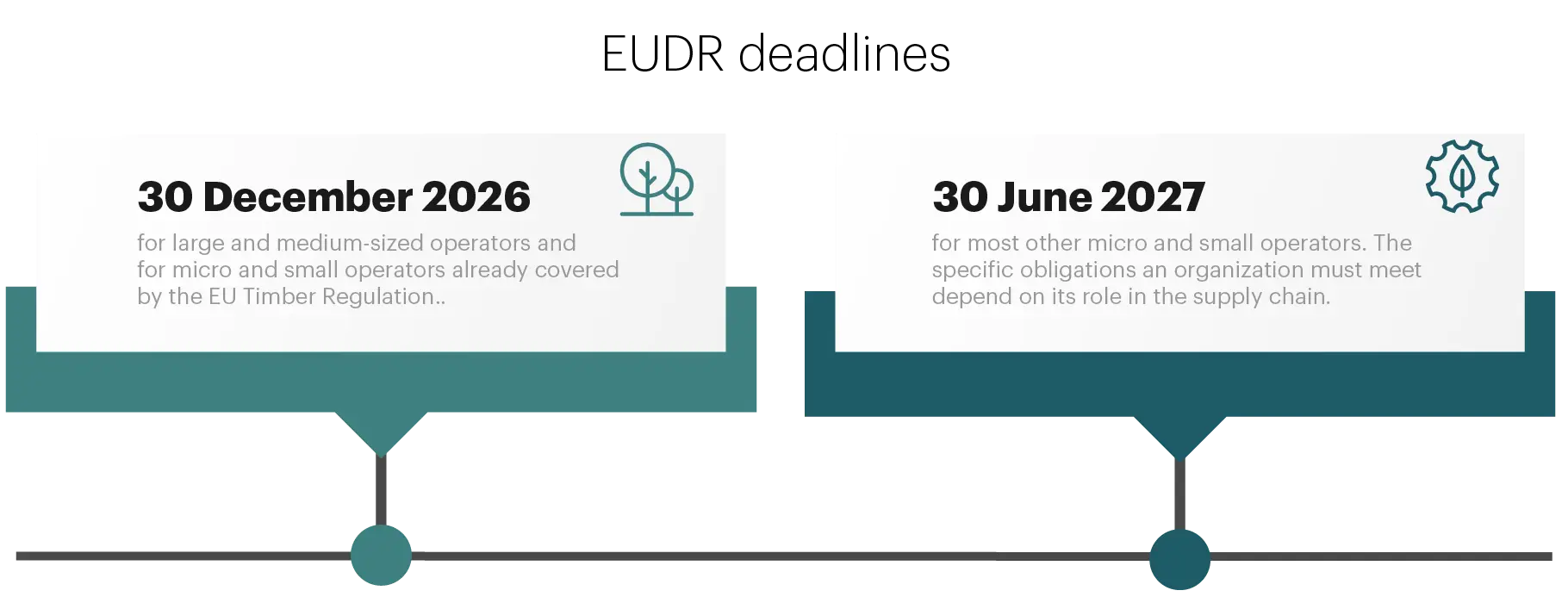
EUDR requirements apply from 30 December 2026 for large and medium-sized operators and for micro and small operators already covered by the EU Timber Regulation. Most other micro and small operators have until 30 June 2027.
Which commodities and products are covered by EUDR?
EUDR covers seven commodities associated with deforestation: cattle, cocoa, coffee, palm oil, rubber, soy, and wood, along with specified derived products. Whether an individual product is in scope depends on the products identified under the regulation.
What is an EUDR risk assessment?
An EUDR risk assessment evaluates whether there is a risk that a relevant commodity or product does not meet the regulation's deforestation-free or legality requirements. Factors can include sourcing geography, supply chain complexity, the reliability and consistency of available information, and the ability to trace commodities back to their production locations.
Who is responsible for submitting an EUDR due diligence statement?
Under the revised EUDR framework, responsibility for submitting a due diligence statement generally sits with the first operator placing a relevant product on the EU market or exporting it. Obligations differ for downstream operators, traders, and certain micro or small primary operators, so organizations should determine which requirements apply to their specific role in the supply chain.
How can EUDR compliance software support supplier data and traceability?
EUDR compliance software can help organizations coordinate supplier collaboration, collect sourcing and geolocation data, maintain supply chain traceability, manage risk assessments, document due diligence activities, and retain evidence in a consistent workflow. Connecting these activities through compliance automation can reduce reliance on spreadsheets, email follow-up, and disconnected compliance processes.
How does e2open support EUDR compliance?
The e2open Supply Suite connects supplier collaboration, supply chain traceability, supplier risk management, due diligence statement management, TRACES-related regulatory data exchange, and supporting compliance records in one environment. This gives supply chain and compliance teams a more repeatable way to collect supplier information, identify risks, coordinate review, and maintain the documentation needed to support EUDR compliance and compliance risk management.
E2open subscription center
Subscribe to receive e2open updates
Interested in learning more? Stay current with the latest e2open news – from company updates to thought-leadership pieces, and so much more!