

How smarter stackability logic helps FTL shippers cut costs without changing their freight.
Shipping full truckloads means you’re already paying for the entire trailer, whether you use all that space or not. That’s why capacity utilization is one of the most reliable ways to reduce transportation spend without renegotiating a single rate. With the right stacking logic built directly into your TMS, those savings start to show up quickly and predictably.
Pallet stacking intelligence provides a practical, rules-based way to use the trailer space you already have, improving rating accuracy, routing decisions, and measurable transportation savings through efficiency.
Why capacity utilization drives FTL cost reduction
FTL shippers pay by the truck, not by the pallet. Every extra pallet you can fit into a trailer reduces the number of loads needed to move a fixed volume of freight.
Take a real-world example: Increasing average pallets per load from 22 to 34 resulted in about 61 fewer loads per year on a 3,800-pallet network. At roughly $2,400 per load, that’s about $145,000 in annual linehaul savings, before touching carrier rates.
That’s the kind of impact that makes capacity utilization one of the highest ROI levers in most transportation value assessments.
Six ways pallet stacking intelligence reduces FTL transportation costs
- Fewer loads for the same volume
More usable pallet space per truck means fewer trucks overall. As the example above shows, even modest improvements compound into major reductions in load count. - Lower linehaul spend
Linehaul is the biggest cost bucket in any FTL budget. Even small gains in trailer utilization translate directly into significant savings. - Better carrier and mode selection
When loads consume fewer pallet spaces, they often qualify for cheaper routing guide tiers, enabling more competitive carriers to be selected. - More accurate rating
If a planner estimates space incorrectly, rating systems often overcharge. Capturing pallet space data at the order, shipment, and equipment levels eliminates “phantom space” and aligns ratings with actual usage. - Reduced accessorials and fewer handling events
Higher utilization can reduce loading/unloading events, touch points, and congestion, helping minimize handling-related charges. - Sustainability and efficiency gains
Fewer trucks mean fewer emissions, less dock activity, and better use of carrier capacity.
What makes pallet stacking intelligence “intelligent”?
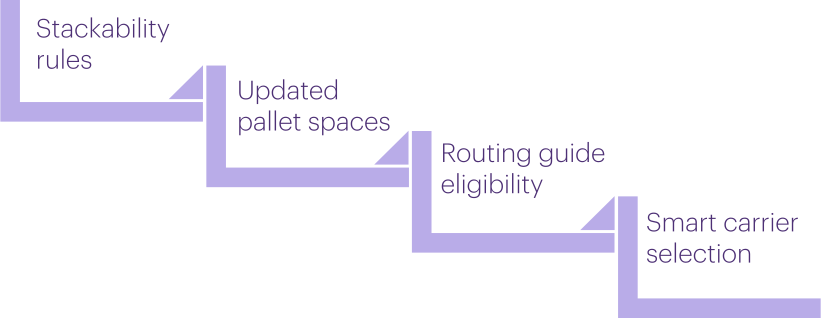
Pallet stacking intelligence uses item and pallet attributes—dimensions, weights, fragility, and stackability flags—plus shipper-defined rules to determine when pallets can be safely stacked. The TMS then optimizes load plans around those combinations.
A few things set this approach apart from manual stacking:
- Rule-driven, data-aware decisions that respect product restrictions and safety limits
- Integration with rating and routing guides, keeping pricing and execution aligned
- Optimization and autobuild support, enabling consistent results without extra overhead
How pallet stacking intelligence improves rating accuracy
Many carriers price based on trailer space, not pallet counts. By calculating pallet space accurately, pallet stacking intelligence helps eliminate overpayments caused by conservative planning assumptions. Because the TMS captures data on pallet space from the order through the equipment, rating stays aligned with the true utilization.

How pallet stacking intelligence improves routing guide performance
Routing guides often include pallet space thresholds. When stackability improves, loads may qualify for different (often cheaper) service tiers or carriers. Advanced Optimization keeps routing guide selection aligned with the optimized load plan, so planners don’t get mismatches between what fits and what gets priced.
The story becomes simple:
What industries benefit the most from pallet stacking intelligence?
Pallet stacking intelligence delivers value across multiple industries—especially those that move predictable, high-volume lanes via FTL:
- Manufacturers, the largest FTL users in the U.S. (31.55% market share in 2025), with steady, repeatable lanes
- Retail and wholesale shippers, moving replenishment loads into and out of distribution centers
- Food and agriculture producers, which often max out weight before cube and benefit from controlled handling
- Construction suppliers, shipping dense, heavy materials to job sites on firm schedules
Each of these shipper types already pays for full trailers. Increasing usable pallet space delivers immediate, meaningful upside.
The bottom line: Why pallet stacking intelligence delivers fast ROI for FTL shippers
Pallet stacking intelligence is one of the simplest, fastest ways for FTL shippers to unlock real transportation savings. Instead of relying on manual judgment, the TMS applies consistent, data-driven rules to improve stacking decisions, increase capacity utilization, and align planning with rating and routing logic. The result is measurable, repeatable cost reduction with the freight you already have.
Ready to see what pallet stacking intelligence could do for your network?
If you want to dig deeper into how e2open TMS helps shippers improve utilization, cut linehaul costs, and align planning with rating and routing logic, we’d be happy to walk you through it.
Contact us to explore whether pallet stacking intelligence is a fit for your operation.


